
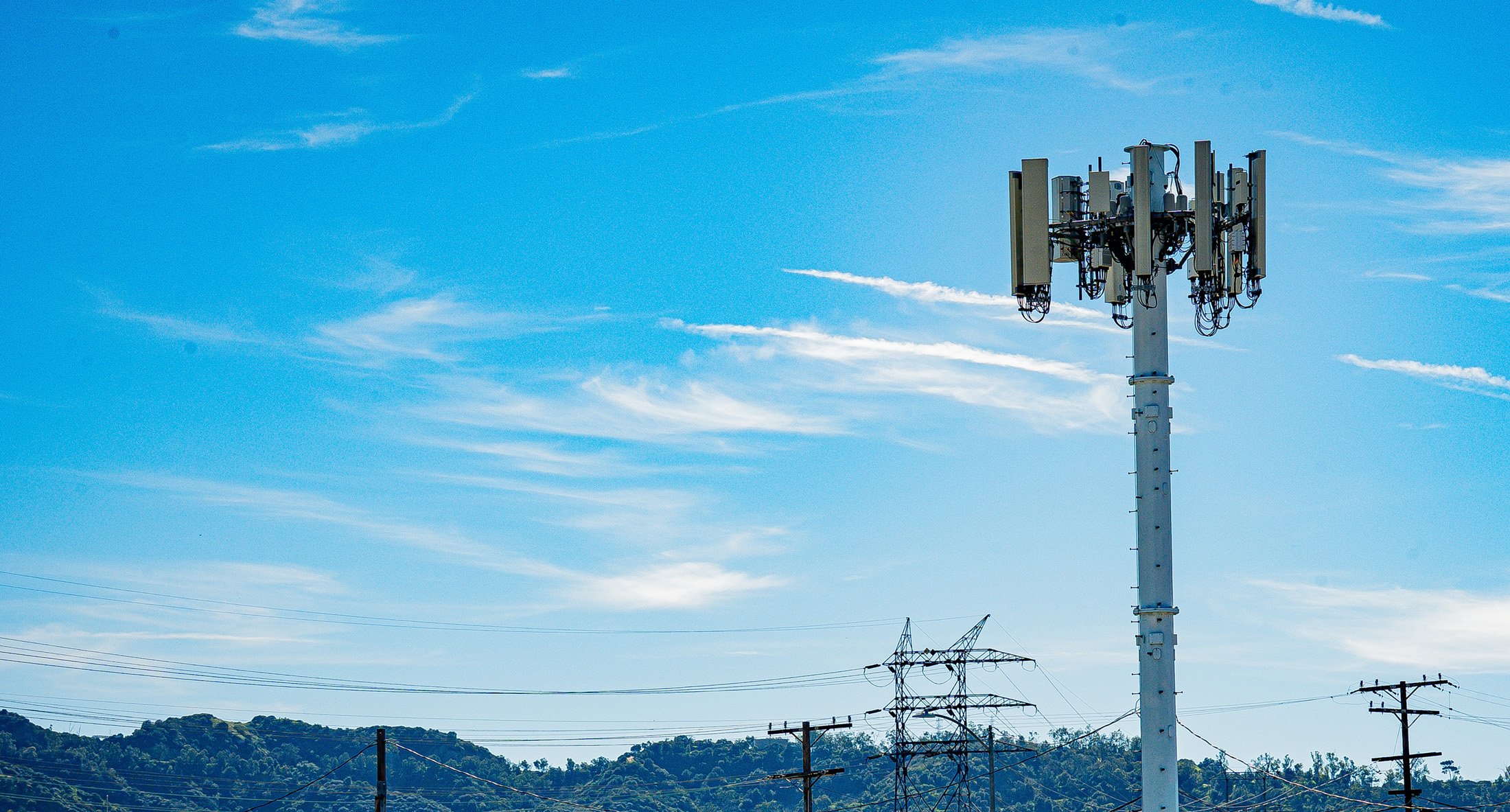
Proposed 150-Foot Cell Tower in Port Ludlow’s North Bay
What Residents Need to Know
A 150-foot industrial cell tower is proposed for Parcel 821081015—directly adjacent to homes in North Bay and the historic Forest Hill Cemetery.
That height matters. At 150 feet, this tower would rise more than twice as high as the surrounding treeline, standing like a 15-story building in the middle of our low-profile, rural community. It would be visible for miles.
The project, led by Horizon Tower, would bring industrial infrastructure—a fenced compound, access road, and ground equipment—into a residential neighborhood. Verizon Wireless is the initial tenant, but the tower is designed to accommodate up to four carriers and 27 more antennas.
Residents support improved cell service. But this location, at this scale, raises serious questions about process, alternatives, and impact on our community.
The applicant states this tower is meant to improve service in Mats Mats—not North Bay or Swansonville. Yet homes near the site would still be in a dead zone.
Why should our residential, historic neighborhood host a 150-foot industrial tower that may not even benefit those who live closest to it?
Residents support better connectivity, but oppose this specific location due to its impact on homes, the adjacent historic cemetery, and our rural character. Better, less intrusive alternatives exist—and they deserve a fair look.
Why This Site Raises Concerns
Many residents are concerned that this particular location prioritizes landowner leasing opportunities over thoughtful siting, potentially creating unnecessary impacts on views, neighborhood feel, property values, and historic resources.
The impacts outlined below illustrate why so many feel this site is poorly chosen, and why stronger public input is essential to ensure any eventual facility aligns with Jefferson County's values of preserving scenic beauty, rural serenity, and quality of life.
Potential Impacts: Why Placement Matters for Our Community
-

Visual and Scenic Impacts
The 150-foot monopole—designed to hold up to 4 carriers and 36 antennas—would rise well above the tree canopy, permanently altering our low-profile rural skyline.
This industrial structure would be visible from homes, roads, trails, and the adjacent historic Forest Hill Cemetery, degrading the scenic views and serene character that define our community. County policies in the Comprehensive Plan emphasize protecting these visual resources. This proposal fails that test.
-

Neighborhood Character and Compatibility
Placing large-scale industrial infrastructure directly adjacent to homes and a historic cemetery shifts this area from quiet residential to something altogether different.
The multi-carrier design allows for future expansion, meaning what goes up as one tower could grow in impact over time. This contradicts the master-planned intent of Port Ludlow's 1968 development and the LMC CC&Rs, which protect our low-density, recreational, residential character.
Zoning matters. This parcel is zoned RR-5—rural residential, intended for homes, garages, and outbuildings. Not this.
-

Property Values and Market Perception
Peer-reviewed research shows visible towers can reduce home values by 2.4–9.78% for properties within roughly 2,300 feet—potentially $17,400 to $120,000 on a $600,000 home. Some studies show impacts exceeding 20% for highly visible towers.
Surveys indicate 90%+ of buyers would pay less or avoid properties near towers due to aesthetics and stigma. In a community where home equity matters, these are real concerns—not speculation.
-

Other Considerations
The SEPA review is incomplete. The current checklist lacks assessment of impacts on wildlife habitat or the adjacent farm with livestock. It mentions no tree removal permit and claims there will be no erosion—despite the fact that construction on rural sites always involves ground disturbance.
Traffic and noise impacts have not been addressed. Heavy trucks carrying equipment and large generators will need to navigate narrow rural roads with sharp corners and culverts not designed for such loads. Generator noise, typically 65–85 dB, will be audible during tests and outages—an impact not yet accounted for.
Federal law limits local decisions on RF emissions if FCC standards are met. That means our focus must remain on land-use factors: location, scale, visual compatibility, noise, traffic, and public notice. These are areas where community input can—and must—make a difference.
We are exploring whether a land use attorney can help clarify if this industrial use aligns with the parcel's RR-5 zoning, which is intended for homes, garages, and outbuildings—not this.
We fully support improved wireless service for Port Ludlow and surrounding areas—reliable cell coverage benefits residents, visitors, emergency services, and businesses alike. This is not opposition to towers or technology. It is about ensuring this specific proposal uses the least intrusive, most effective site possible, as required by Jefferson County codes (UDC Ch. 18.42) and best practices for wireless facilities.
The applicant must demonstrate that this parcel is the most suitable option. That requires a good-faith analysis of colocation on existing structures and a genuine evaluation of alternative sites.
Our community aligns with Jefferson County's own vision of preserving natural beauty, scenic views, rural character, and open space while balancing growth and connectivity. By exploring better options, the project could deliver improved service for the intended coverage area—Mats Mats and beyond—with fewer drawbacks for North Bay residents. This is about thoughtful planning, not resistance to progress.
In comments to the county, residents can request:
A detailed site-search report showing why alternatives were ruled out.
RF propagation simulations comparing this site to higher or more distant options.
Emphasis on colocation feasibility under county standards.
Better Solutions Exist!
Community members and experts note that rural wireless siting often succeeds by prioritizing:
-
(e.g., attaching antennas to utility poles, water tanks, buildings, or other towers where structurally and technologically feasible)—Jefferson County explicitly encourages this to minimize new builds and visual clutter.
-
The proposal appears aimed primarily at addressing dead zones in Mats Mats Bay/Quarry (~3–4 miles north). Placing the tower (or additional ones) closer to that area—such as on recently cleared lumber lands, public works yards, utility corridors, or county-owned/industrial sites—could provide stronger, more direct coverage without rising above the tree canopy in a residential/historic zone.
-
Camouflaged monopoles, shorter structures, or distributed small-cell options in less sensitive locations, as seen in other Washington counties (e.g., incentives for colocation and preferred land-use areas in Snohomish and Langley ordinances).
-
Sites like DNR-managed communication areas (hilltops/mountaintops on state trust lands) or county facilities that already host similar infrastructure, reducing the need for new residential-area towers.
The Legal and Regulatory Framework:
Our Rights and the County's Role
Understanding the rules that govern this process is key to an effective response. Jefferson County must review the application for a Conditional Use Permit, guided by specific codes and state laws. These rules provide us with several strong levers to ensure this proposal gets the scrutiny it deserves.
Jefferson County Unified Development Code (UDC) — Chapter 18.42
This is the county's primary tool for reviewing cell towers. It doesn't just allow them; it establishes a strict hierarchy of preferences and requirements. The code prioritizes colocation on existing structures first. Only if that’s proven infeasible should a new tower be considered, and even then, it must be the least intrusive option possible, with full visual mitigation and demonstrable compatibility with the surrounding neighborhood.
State Environmental Policy Act (SEPA) — RCW 43.21C
SEPA is our most powerful tool to demand a complete picture. It requires a full environmental and cultural review before any permit is issued. Given the site's proximity to a historic cemetery, a working farm, and rural residential areas, we have the right to push for a thorough assessment of all potential impacts—from visual and noise pollution to effects on wildlife and traffic. The current notice appears incomplete on these critical points.
Protection of Historic Cemeteries
RCW 68.60
This state law provides specific, strong protections for all burial sites, regardless of whether they are in an active cemetery. Locating a massive industrial project immediately adjacent to the historic Forest Hill Cemetery raises serious concerns under this law. Any disturbance or desecration is not just a community issue; it is a legal one.
The Growth Management Act (GMA)
RCW 36.70A
The GMA guides all growth in Washington to preserve rural character and natural resources. An industrial cell tower in a Rural Residential zone must be carefully scrutinized to ensure it aligns with the GMA's mandate to protect our community's quality of life. The applicant may try to classify the tower as an "essential public facility," but that designation does not override the need for strict adherence to all other zoning and compatibility requirements.
The Land Use Petition Act (LUPA)
RCW 36.70C
This is our path to appeal. If the county approves a permit without following its own rules or fully considering the evidence, LUPA provides a legal avenue for citizens to challenge that decision in court.

A Note on Federal Law
It is important to know what this process cannot address. Federal law (The Telecommunications Act of 1996) prevents local jurisdictions from denying a permit based on concerns about the potential health effects of radio frequency (RF) emissions, as long as the facility meets FCC standards.
Therefore, our comments and questions must focus on the areas where local and state law give us a voice:
Location & Site Selection: Was this truly the only feasible site, or were better alternatives ignored?
Scale & Appearance: Is a 150-foot tower compatible with our rural, residential community?
Environmental & Historic Impacts: What are the real costs to our environment, our history, and our quality of life?
Process & Notice: Was the process fair, transparent, and complete?
Take Action
Strong community input can influence denial, conditions, or relocation.

Attend Key Meetings
A public hearing before the Hearing Examiner is expected—date TBD. The county will provide official notice. We will also share updates as soon as they are scheduled.
Spread the Word
Talk to your neighbors.
Request time on LMC and PLVC meeting agendas.
Encourage local organizations to take a formal position.
Get Involved
The opposition committee needs volunteers. Contact us to help.
📧 Email: plcelltoweropposition@gmail.com
📬 Mail: PL Cell Tower Opposition Committee, 46 Village Way PMB 118, Port Ludlow, WA 98365
Submit Comments to the County — This is the most critical step.
Send your opposition letter to Jefferson County. Comments become part of the official record and carry significant weight.
Email: dcd@co.jefferson.wa.us
Mail: Greg Ballard, Jefferson County Department of Community Development, Development Review Division, 621 Sheridan Street, Port Townsend, WA 98368
Reference: Parcel 821081015 or Application ZON2025-00011
Need help getting started? Contact us for a template.
Monitor the Application
Track official updates and documents through the county permitting portal.
🔗 Jefferson County Permitting Portal
Search: ZON2025-00011 or Parcel 821081015